
 leereilly

Join us this October by participating in the fifth annual Hacktoberfest, a month-long celebration of open source software. Along with welcoming back our friends at Digital Ocean, Twilio has joined our partnership for its first year in celebrating Hacktoberfest.
It’s easy to join in on the fun (and get a limited-edition shirt!), all you have to do is check the Hacktoberfest website for details on how to enter. Then, submit 5 pull requests to open source projects between October 1st and 31st. That’s it! The first 50,000 people to complete the challenge will earn a limited edition Hacktoberfest shirt. Terms and conditions will be posted on the website prior to the start of the contest.

If you’ve never contributed to an open source project before, you don’t have to miss out on all the fun—check out our contributing to open source guide.
Want to share your love for Hacktoberfest? Tell the world with the #hacktoberfest hashtag on Twitter, Facebook, or Instagram.
Last year, 30,000+ people from over 100 countries (119 to be exact!) submitted almost 240,000 pull requests to all kinds of projects—everything from documentation tweaks and bug fixes, to new features and performance improvements. See their stories and (and selfies!) on Twitter with #hacktoberfest.
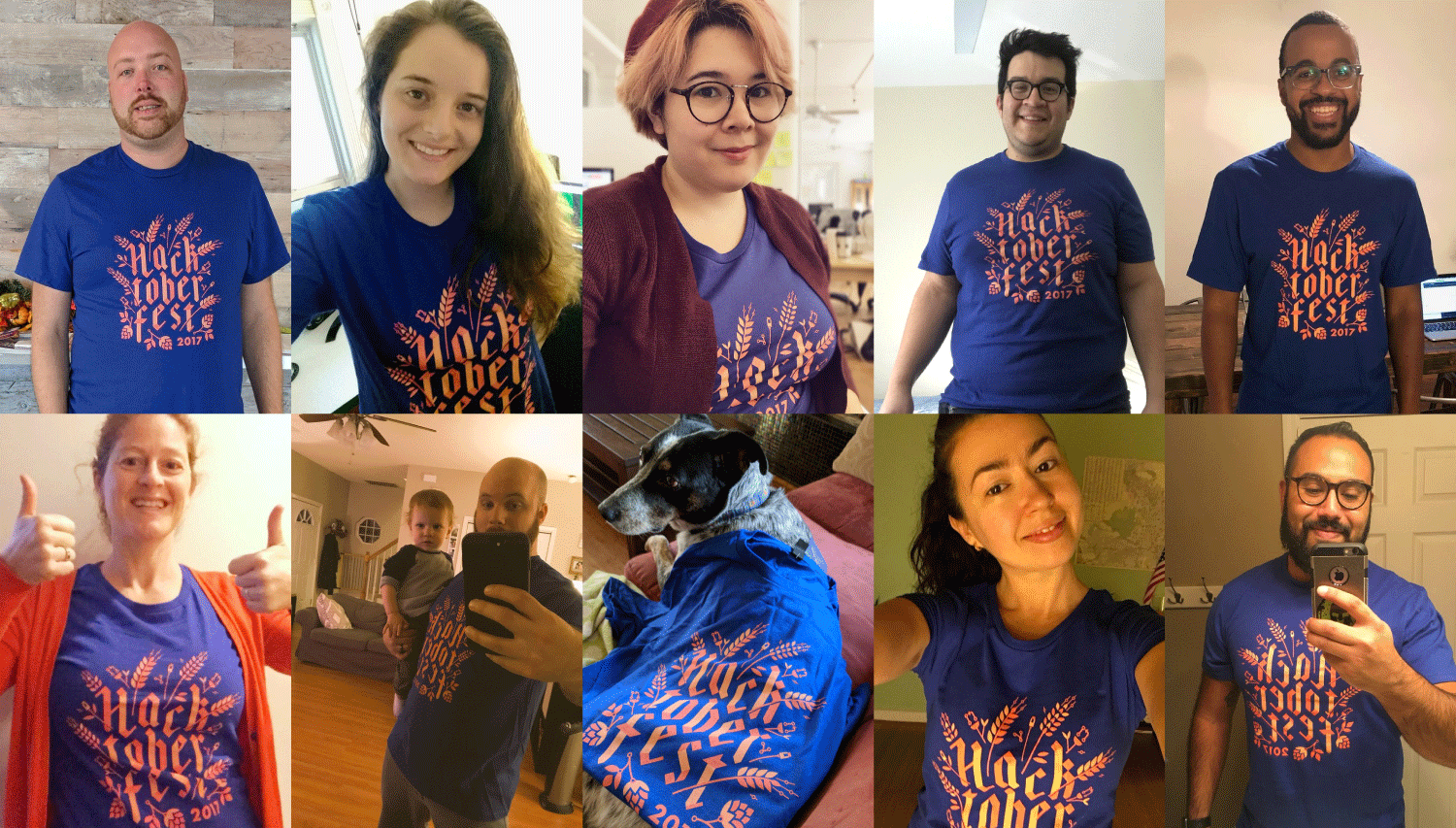
Don’t miss out! Check the Hacktoberfest website and sign up to receive updates
 joenash

New tools added to the GitHub Student Developer Pack will make your projects ship faster, shine with robust features, and help you stand out from the crowd.
These powerful new additions are free with the GitHub Student Developer Pack, so you can start the school year off right:
On top of that, our friends at GitKraken added Glo Boards, their issue and task tracker, to help you stay on top of your school work.
Does your app have search functionality? Why not add it with Algolia.
Algolia is a search API that gives developers a complete toolkit for building search into their products - from front end libraries to back end frameworks and API clients. Now that they’re included with the GitHub Student Developer Pack, you’ll get 100,000 records for your index, and one million indexing operations monthly for free (a value of $150 monthly).
Build out discoverability features for your app so your users can find what they’re looking for.

Keeping track of everything you need to do for class can be a chore, and group projects can be especially challenging. That’s where GitKraken Glo comes in with the easiest way to track tasks from inside the GitKraken Git Client, a browser, mobile apps, or even Atom and VS Code. Glo Boards sync in real-time with GitHub Issues to help visualize your to-do list in a workflow or calendar view. Track individual and team progress, and use @mentions to keep everyone on task.

GitKraken offers these legendary task tracking boards with GitHub Issue sync, free for 1 year (normally $49 yearly) through the GitHub Student Developer Pack.
If you’re building a web application at a hackathon, Heroku is your new best friend. The cloud-based, platform as a service (PaaS) gives you everything you need to do your best work. This includes a fully-managed runtime environment, coupled with a wide range of tools and built-in services. Build apps with the language or framework of your choice. It’s a great place to practice popular architectural patterns or collaborate with other students. For example, developers use the “review apps” feature to share changes immediately with every commit to GitHub. Because Heroku takes care of DevOps, you can focus on becoming a better developer.
All Heroku applications run in a collection of lightweight Linux containers called dynos. With the GitHub Student Developer Pack, you’ll get a Hobby Dyno to run small projects for up to 2 years (valued at $84 yearly).
These integrated development environments will change your life. If you’re learning Java, PHP, Ruby, Python, JavaScript, Kotlin, Objective-C, Go, or .NET, you can quickly get started with ease using professional developer tools from JetBrains.
With the GitHub Student Developer Pack, you get a free year-long subscription to all JetBrains desktop tools, including IntelliJ IDEA Ultimate, PyCharm Professional, CLion, and Rider. As long as you remain a student, you’re welcome to renew your Student License for free.
 samlambert
Software developers are most productive when software development is inclusive and accessible. At GitHub, we conduct research in machine learning, design, and infrastructure to make sure everyone can do their best work with the next generation of developer tools and workflows.
This research can take considerable time to reach you, our end users, if it reaches you at all. We rigorously evaluate products for stability, performance, and security. And many experiments don’t meet our success criteria for product release, even when they present a path forward for future innovation.
Although we can’t share everything we do, we’ve launched a collection of demonstrations highlighting our most exciting research projects—and the ideas behind them—with Experiments. We hope these will not only give you insight into our research but inspire you to think audaciously about the future of software development.
For our first demo, we’ve chosen Semantic Code Search. We’ve used machine learning to build semantic representations of code that allow you to use natural language to search for code by intent, rather than just keyword matching. See our blog post for additional detail on how this works.

We’re just getting started, so stay tuned for more examples. If this research excite you as much as they excite us, why not join our team?
 vollmera
Last week, we put out a call to action leading up to the EU Parliament’s vote on the Copyright Directive. Read on to learn what they decided, how this affects software, and what’s next in the process. (It’s not over.)
On September 12, the EU Parliament voted to:
If Parliament’s version of the Copyright Directive becomes the law:
But remember, Parliament doesn’t have the final word. We still need to keep an eye on the negotiations as they move to the next stage with the Council and Commission—and continue advocating to protect software.
There’s a lot to fix in the current copyright proposal. We’re looking at software because that’s where developers can speak with authority. Our focus now is on the negotiations among Parliament, Council, and the Commission (trilogues) to ensure exclusion for “open source software developing platforms” isn’t only limited to “non-for-profit” platforms. This was our goal back in April too, when both Council and Parliament proposed excluding only “non-for-profit open source software developing platforms.” With your help, we were able to show Parliament why a non-for-profit limitation would undermine their effort to protect software because most open source software development is built on platforms, like GitHub, that aren’t non-for-profit.
Now it’s time to make this clear for the Council. After hearing from developers, Parliament realized it didn’t make sense to limit the software exclusion to only non-for-profit software development platforms. We need to make sure the Council understands this, too. EU developers, contact your Council members and explain why they need to exclude all open source software development platforms from filtering obligations—not only non-for-profit ones—if they want to effectively protect software development in the EU.
Copyright law hasn’t kept up with the digital age, and we support greater copyright reform that protects how software development happens around the world today. But as we’re fixing copyright law, it’s important to make sure that we aren’t actually creating more problems. Although the Copyright Directive may be a step forward, we have to continue advocating for fair and balanced change that protects software—and the economy it powers—in the process.
 gagansandhu1980

Whether you use GitHub independently or with a team, we are proud to offer unparalleled support to everyone in our community. Over time we’ve learned that some teams require around-the-clock care and peace of mind that extend beyond our standard support offering. For these customers, we introduced Premium Support at last year’s Universe. Today we’re building on our initial launch and announcing an improved Premium Support program featuring two new plans: Premium and Premium Plus.
Both plans include:
Premium Plus also includes:
View the new Premium Support program, or contact us to learn more.


