<?xml version="1.0" encoding="UTF-8"?><?xml-stylesheet type="text/xsl" href="https://sniggle.net/TPL/rss10.xsl"?><rdf:RDF
  xmlns:rdf="http://www.w3.org/1999/02/22-rdf-syntax-ns#"
  xmlns:dc="http://purl.org/dc/elements/1.1/"
  xmlns:sy="http://purl.org/rss/1.0/modules/syndication/"
  xmlns:admin="http://webns.net/mvcb/"
  xmlns:content="http://purl.org/rss/1.0/modules/content/"
  xmlns:cc="http://web.resource.org/cc/"
  xmlns="http://purl.org/rss/1.0/">

<channel rdf:about="https://sniggle.net/TPL/">
<title>The Picket Line</title>
<link>https://sniggle.net/TPL/</link>
<description>When the war on Iraq started, I stopped paying the federal income tax and started working for my values instead of against them. I quit my job and deliberately reduced my income to the point where I no longer owe federal income tax.</description>
<image>
   <url>https://sniggle.net/TPL/tpl.gif</url>
   <title>The Picket Line</title>
   <link>https://sniggle.net/TPL/</link>
   <width>88</width>
   <height>31</height>
   <description>The Picket Line</description>
</image>
<dc:language>en-US</dc:language>
<dc:date>2026-07-11</dc:date>

<items><rdf:Seq>
<rdf:li rdf:resource="https://sniggle.net/TPL/index5.php?entry=10Jul26" />
<rdf:li rdf:resource="https://sniggle.net/TPL/index5.php?entry=29May26" />
<rdf:li rdf:resource="https://sniggle.net/TPL/index5.php?entry=28Apr26" />
<rdf:li rdf:resource="https://sniggle.net/TPL/index5.php?entry=12Apr26" />
<rdf:li rdf:resource="https://sniggle.net/TPL/index5.php?entry=19Mar26" />
</rdf:Seq></items>
</channel>

 <item rdf:about="https://sniggle.net/TPL/index5.php?entry=10Jul26">
  <title>I Seem to Be Retired; What Now? · TPL</title>
  <description>I find myself suddenly retired, and realize that I have to totally retool my tax resistance strategy as IRA draw-downs, Medicare and Social Security, and required minimum distributions show up, and as I stop generating earned income and my familiar tax deductions go away. This is my first attempt to game out the coming years.</description>
<dc:subject>How you can resist funding the government →
 getting under the income tax line →
 how it’s done →
 IRAs, 401(k)s, and other retirement accounts</dc:subject>
<dc:subject>How you can resist funding the government →
 a survey of tactics of historical tax resistance campaigns →
 redirect resisted taxes to charity →
 see also</dc:subject>
<dc:subject>How you can resist funding the government →
 other tax resistance strategies →
 charitable giving</dc:subject>
<dc:subject>How you can resist funding the government →
 other tax resistance strategies →
 frugality / simple living / self-sufficiency →
 FIRE (financial independence, retire early)</dc:subject>
<dc:subject>How you can resist funding the government →
 my tax resistance →
 budget check</dc:subject>
<content:encoded><![CDATA[<header><h1 class="date"></h1></header><article>
<p>
 I have, to my surprise, suddenly retired.
</p><p>
 This has various ramifications, mostly pleasant ones, but among which is that I need to retool my tax resistance strategy.
 That strategy has until now involved avoiding or resisting taxation on earned income by means of things like tax-deferred retirement contributions.
 Now I have to prepare for a future without any earned income to speak of, in which I will instead be drawing down those tax-deferred accounts.
</p><p>
 This is my first draft of a game plan for the coming years.
 There are a lot of moving parts and a lot of uncertainty, and so it’s been challenging to draw this up.
</p><p>
 I decided not to adjust numbers for inflation.
 I figure that allowable <abbr class="initialism caps" title="Health Savings Account">HSA</abbr> deductions, standard deductions, Social Security, etc. will more or less track inflation and so it will be a wash as far as my calculations are concerned.
 I also assume a 3% real rate of return on invested money, which I understand is considered to be on the conservative end of what is likely (but who knows?).
</p><p>
 The further my plans go into the future the more unreliable they are because of all of the unknowns (what will the market do? what will Congress do about Social Security? will artificial intelligence turn us all into paperclips?).
 For want of a way to meaningfully plan for possible scenarios like the collapse of the <abbr class="initialism caps" title="United States">U.S.</abbr> government, the global dominance of artificial superintelligence, and so forth, my scenarios instead assume that the future will be more or less a later-to-arrive version of the present, in which I am older but playing essentially the same game by the same rules.
 I’m posting this here today in part so I can look back at it and laugh later.
</p><p>
 The biggest unknown, or one that looms large in my mind anyway, is how long I’ll be around to enjoy retirement.
 One can’t count on even one more day, but one ought to plan ahead anyway.
 The typical life expectancy for someone my age is something like 81.
 But my parents are both alive and on the cusp of 90 and three of my four grandparents made it into their 90s too, so I think I should be prepared for the possibility that I may stick around longer.
</p><p>
 My goal is to have a comfortable and secure retirement (and hopefully a long and healthy one) and to continue to successfully resist funding the U.S. government.
 Can I do that if I retire today?
</p><p>
 Just about every year since I started resisting, I’ve put aside 40–50% of my income into tax-deferred retirement accounts and a health savings account (<abbr class="initialism caps" title="Health Savings Account">HSA</abbr>).
 In years when my income was lower than it needed to be to avoid the federal income tax, I’ve transferred some of the tax-deferred money into a Roth <abbr class="initialism caps" title="Individual Retirement Account">IRA</abbr>, taking that amount as current-year income while staying within the 0% tax bracket.
 A couple of years back I stopped using the <abbr class="initialism caps" title="Health Savings Account">HSA</abbr> to pay for health expenses and started using it as another retirement savings vehicle.
</p>
<h1>Early Retirement: Ages 57½–59½</h1>
<p>
 So I start with a pretty good hunk of change in retirement accounts.
 However, I’m only 57½.
 I cannot begin to tap these accounts without penalty until I turn 59½, with a couple of exceptions:
</p>
<ol>
 <li>I can withdraw from my <abbr class="initialism caps" title="Health Savings Account">HSA</abbr> to pay for past health expenses I had paid for out-of-pocket (yes, I saved the receipts), and for current health expenses.</li>
 <li>I can withdraw from my Roth <abbr class="initialism caps" title="Individual Retirement Account">IRA</abbr> any principal I added at least five years ago (but not any gains, or anything I added more recently).</li>
</ol>
<p>
 So for the next two years, before I turn 59½, I need to live off of my current cash savings (~$24k) + about $2k from my <abbr class="initialism caps" title="Health Savings Account">HSA</abbr> + about $38k from my Roth = $64k.
 Can I do that?
</p><p>
 My current spending runs to about $27k per year in rent, food, etc. (not counting health expenses for which I could tap the <abbr class="initialism caps" title="Health Savings Account">HSA</abbr>).
 $64k gives me twice that and then some, so that feels safe to last two years.
</p><p>
 I have brought in only about $15k in earned income this year.
 But I was making <abbr class="initialism caps" title="Health Savings Account">HSA</abbr> and <abbr class="initialism caps" title="Individual Retirement Account">IRA</abbr> deposits as though I were going to earn a standard year’s income.
 As a result I have way more deductions than I need to shield that much income from income tax.
 This gives me the opportunity to generate more tax-free income by doing another Roth transfer this year, probably to the tune of $43k or so.
 That will help later on.
</p>
<h1>Pre-Medicare: Ages 59½–65</h1>
<p>
 When I turn 59½ I can start drawing down both my tax-deferred and Roth <abbr class="initialism caps" title="Individual Retirement Account">IRA</abbr>s as much or as little as I’d like.
 (Starting at age 75, required minimum distributions may change this calculus a bit; I’ll get to that later.)
</p><p>
 If I pull no more than $22k from my tax-deferred <abbr class="initialism caps" title="Individual Retirement Account">IRA</abbr> per year, and deposit the maximum (currently $5,400) in my <abbr class="initialism caps" title="Health Savings Account">HSA</abbr>, this will result in an adjusted gross income less than the standard deduction, resulting in no taxable income.
 (This also ensures that I remain eligible for Covered California’s high-deductible health insurance plan, so I can make <abbr class="initialism caps" title="Health Savings Account">HSA</abbr> deposits.)
 Because none of this income is considered <em>earned</em> income in the current tax year; there is also zero self-employment / social security tax.
 If I supplement that ~$16k spending money with another $21k from my Roth <abbr class="initialism caps" title="Individual Retirement Account">IRA</abbr>, that gives about $37k in spending money.
</p><p>
 For the next several years I hope that the <abbr class="initialism caps" title="Internal Revenue Service">IRS</abbr> will continue to drop the ball on my past tax debt, letting it fall off the statute of limitations cliff year after year as they have for several years now.
 When they do this, I typically celebrate by making a charitable donation equal to the amount of the successfully resisted taxes.
 I hope to keep doing this, but this means subtracting $4–$6k from that $37k of spending money.
 But that still leaves me comfortably above my $27k budget, so I think I’m okay here.
</p>
<h1>Medicare Kicks In: Ages 65–69</h1>
<p>
 When I have to join Medicare at age 65, I lose my high-deductible health insurance plan and can no longer contribute to my <abbr class="initialism caps" title="Health Savings Account">HSA</abbr>.
 Medicare also has substantially more expensive premiums than my current plan.
 As a result, my healthcare expenses rise, and an important tax deduction vanishes.
</p><p>
 This will be a good time to start tapping my <abbr class="initialism caps" title="Health Savings Account">HSA</abbr> to pay for these extra expenses.
</p><p>
 On the up side, my standard deduction increases to the You’re Officially Old level.
</p><p>
 In 2037, if things go well, the last of my tax debts will be eliminated by the statute of limitations.
 I’ll make my usual charitable donation and will have no remaining federal tax debt.
</p><p>
 Things are a little iffy toward the end of this 65–69 range: it’ll be touch-and-go depending on the market and on how frugal I’ve been in the previous years, but I may exhaust my Roth toward the end of this period.
 If so, I have options.
 I might tap the <abbr class="initialism caps" title="Health Savings Account">HSA</abbr> to reimburse for past medical expenses (if I still have any stored up), or I might have to take more out of my tax-deferred <abbr class="initialism caps" title="Individual Retirement Account">IRA</abbr>, which could put me into taxable income territory.
 Another option would be to apply for Social Security earlier than I otherwise planned to.
</p>
<h2>What if the <abbr class="initialism caps" title="Internal Revenue Service">IRS</abbr> Seizes that Tax Debt?</h2>
<p>
 The <abbr class="initialism caps" title="Internal Revenue Service">IRS</abbr> has failed, for many years running, to collect taxes they say I owe them.
 But this isn’t because I have some great ninja asset-hiding scheme.
 I haven’t buried my <abbr class="initialism caps" title="Individual Retirement Account">IRA</abbr> in a hole in a tax haven or anything like that.
 I’ve just been overlooked by a dysfunctional bureaucracy.
 That could change at any time.
</p><p>
 The total amount I owe at this point is a little under $90k.
 If the <abbr class="initialism caps" title="Internal Revenue Service">IRS</abbr> seizes money from some account of mine, that may have additional tax implications.
 If they seize it from a tax-deferred retirement account or from my <abbr class="initialism caps" title="Health Savings Account">HSA</abbr>, the amount they seize would count as potentially-taxable income in the year it was seized.
 (I think early-withdrawal penalties are waived in such a circumstance, but if not, that too might be an issue if this happens before I turn 59½.)
 If they seize it from my bank account or from my Roth, that leaves less in those accounts for me to use to offset potentially-taxable income.
</p><p>
 In short, such a seizure could throw a wrench in my plans, and I’d have to rejigger things.
</p><p>
 Because it’s difficult to predict if, when, or in what manner this might happen, I haven’t tried to account for this in my scenarios.
 But it’s a Sword of Damocles that dangles over these plans and could disrupt them a bit.
</p><p>
 One thing I’m unsure about is whether the act of beginning to draw down my retirement accounts will make those accounts more salient to <abbr class="initialism caps" title="Internal Revenue Service">IRS</abbr> enforcers.
 I think they tend to be reluctant to seize money from retirement accounts; but this may be more the case when those accounts represent retirement savings than when they represent retirement income.
 It’s possible that beginning to take <abbr class="initialism caps" title="Individual Retirement Account">IRA</abbr> withdrawals may trigger a levy.
</p><p>
 Of the ~$90k in tax debt, about a third of it is interest and penalties added by the <abbr class="initialism caps" title="Internal Revenue Service">IRS</abbr> to the amount I originally did not pay.
 If seized from me, I could apply to the <a href="https://nwtrcc.org/wtrpf/">War Tax Resisters Penalty Fund</a> for reimbursement of these penalty-and-interest amounts.
 The fund has a good record of reimbursing requests like these, but it has not seen many requests in recent years, and a request for ~$30k would be an especially large one, so it is uncertain how much reimbursement I could expect from such an application.
 I am not sure whether such a reimbursement would officially be considered taxable income or more along the lines of a gift.
</p>
<h1>Social Security Kicks In: Ages 70–74</h1>
<p>
 When I hit age 70, I must begin taking Social Security (I could start earlier, but I think it is to my advantage to wait).
 In current dollars, my expected benefit is about $35k/year.
 (The Social Security trust fund is expected to give out by then, which could mean a reduction in benefits if Congress has the guts to try that.
 This would change some of the numbers that follow, but not the basic strategy.)
 Social Security benefits are taxable, but only according to a strange formula:
</p>
<ul>
 <li>If your “combined income” is &lt; $25k, they aren’t taxed at all.</li>
 <li>If your “combined income” is between $25k and $34k, half of your Social Security benefits become part of your adjusted gross income.</li>
 <li>If your “combined income” is &gt; $34k, 85% of your Social Security benefits become part of your adjusted gross income.</li>
</ul>
<p>
 So my best bet for avoiding federal income tax entirely is to keep my “combined income” below $25k.
 What is “combined income” you ask?
 It seems to be whatever would be my adjusted gross income anyway (at this point: what I pull from my tax-deferred <abbr class="initialism caps" title="Individual Retirement Account">IRA</abbr>, plus any Roth conversions) plus half of my Social Security benefits.
</p><p>
 Naïvely, if I were to continue to withdraw about $20k/year from my <abbr class="initialism caps" title="Individual Retirement Account">IRA</abbr>, my “combined income” would be about $38k, which is too much.
 So what can I do about that?
</p><p>
 There’s a trick called “qualified charitable distributions” that allows retirees after age 70 to transfer money directly from their tax-deferred retirement accounts to certain types of charities; when they do so the amount of the transfer does not count as income.
 So if I get $35k in Social Security, withdraw $7k from my <abbr class="initialism caps" title="Individual Retirement Account">IRA</abbr> to supplement that, and donate $13k to charity from my <abbr class="initialism caps" title="Individual Retirement Account">IRA</abbr>, the numbers look something like this:
</p>
<ul>
 <li><b>Spending money:</b> $35k + $7k = $42k</li>
 <li><b>Combined income:</b> $35k÷2 + $7k =  $24.5k</li>
 <li><b>Adjusted gross income:</b> $7k</li>
</ul>
<p>
 So I remain tax-free despite the new income source, and indeed my spending money budget can go up.
 If I stay frugal, I can even use some of this extra money to rebuild my Roth by means of Roth conversions.
 That may come in handy later on when my <abbr class="initialism caps" title="Health Savings Account">HSA</abbr> runs out (around age 77 according to my projections).
</p><p>
 Social Security can be seized by the <abbr class="initialism caps" title="Internal Revenue Service">IRS</abbr> to satisfy tax debt.
 (Typically only 15% of your check can be seized, but more can if The Man decides to make a big deal about it.)
 However if things go well I won’t have any remaining tax debt by the time I turn 70, so this won’t be an issue.
</p><p>
 You may wonder why I plan to withdraw anything at all from my <abbr class="initialism caps" title="Individual Retirement Account">IRA</abbr> at this point, since the Social Security benefit by itself wouldn’t be taxable and yet would be enough for me to live on comfortably.
 The answer is that I <em>have to</em> withdraw some of that money eventually — see below — and so there’s no real disadvantage to doing so at this stage if there’s plenty to be had.
 If I don’t have any spending needs to justify the withdrawals, I can take them in the form of Roth conversions and charitable contributions.
 If the market tanks, I can leave my <abbr class="initialism caps" title="Individual Retirement Account">IRA</abbr> alone and coast on Social Security for a while.
</p>
<h1>Required Minimum Distributions: Ages 75+</h1>
<p>
 At age 75, another rule kicks in: I must take a certain amount from my tax-deferred <abbr class="initialism caps" title="Individual Retirement Account">IRA</abbr> every year whether I want to or not (up to now, whether and how much to withdraw has been entirely up to me).
 The amount I have to withdraw is based on the amount in the account and my age.
 Under the projections I’m working with, this will have the effect of slightly increasing the amount I withdraw from my <abbr class="initialism caps" title="Individual Retirement Account">IRA</abbr>.
</p><p>
 But because of the “qualified charitable distributions” trick described above, I can simply increase my charitable giving to match and thereby continue to keep my combined income and adjusted gross income numbers below their respective lines.
</p><p>
 I’ve run the numbers through 2068 at which time, if I am still alive and kicking, I will celebrate my 100<sup class="ordinal">th</sup> birthday.
 Should I be so lucky, according to my best-guess estimates, I will have spent about $2.3 million in today’s money on my own modest upkeep during retirement, will have given about $600k to charity, and will still have a little gas in the <abbr class="initialism caps" title="Individual Retirement Account">IRA</abbr> tank in case they’ve invented a miracle longevity pill or I want to leave a bequest somewhere or other.
 When I look at it that way, I feel astonishingly wealthy and fortunate (though fortune may have its own ideas for my future).
 Yet, when I describe my frugal retirement strategy to others I not infrequently am met with a response that suggests I’m consigning myself to sad poverty or something like that.
</p><p>
 What if I have unusual expenses I haven’t anticipated here, e.g. I need long-term care or I want to take a bucket list vacation somewhere fancy or I want to replace my failing body with the latest consumer model robot parts?
 Well, I <em>do</em> have a considerable extra room in my potential budget if I’m willing to step over the taxable income line.
 If in some year I need to spend thousands of dollars on some emergency (or splurge) expense, I can withdraw a little extra from the <abbr class="initialism caps" title="Individual Retirement Account">IRA</abbr> or I can neglect to make a charitable donation that year.
 This makes me vulnerable to income tax, but I can always just neglect to pay the tax and try my luck against the <abbr class="initialism caps" title="Internal Revenue Service">IRS</abbr> enforcement bureaucracy, which has been a good bet thusfar.
</p><p>
 Of course, nothing will turn out exactly like I’ve planned.
 Trying to project things 40 years into the future based on the current financial economy and political economy and my current lifestyle needs is nuts.
 But as a back-of-the-envelope calculation to help me figure out whether now is a good time to attempt to slip into a secure retirement and continue to resist, it’s been a good exercise and has given me the confidence to go ahead.
 It’s also helped me to plot out some strategies I can use along the way (if I stay alert for changes and remain flexible) to make things go easier.
</p>

<table>
 <thead>
  <tr>
   <th>ages</th>
   <th style="white-space: nowrap;">0-tax target</th>
   <th>strategy</th>
  </tr>
 </thead>
 <tbody>
  <tr>
   <td style="white-space: nowrap; vertical-align: top;">57½–59½</td>
   <td style="white-space: nowrap; vertical-align: top;"><abbr class="initialism caps" title="adjusted gross income">AGI</abbr> &lt; $16,100</td>
   <td><b>Limited Liquidity:</b> Spend down cash, use Roth principal to supplement. Continue maximum deposit to <abbr class="initialism caps" title="Health Savings Account">HSA</abbr>. Do Roth conversions to fill out your 0% bracket. Pay medical expenses without dipping into the <abbr class="initialism caps" title="Health Savings Account">HSA</abbr>. Continue ~$5k/year charitable contributions. Your post-medical spending budget is ~$30k/year.</td>
  </tr>
  <tr>
   <td style="white-space: nowrap; vertical-align: top;">59½–65</td>
   <td style="white-space: nowrap; vertical-align: top;"><abbr class="initialism caps" title="adjusted gross income">AGI</abbr> &lt; $16,100</td>
   <td><b><abbr class="initialism caps" title="Individual Retirement Account">IRA</abbr>s available:</b> Tap tax-deferred <abbr class="initialism caps" title="Individual Retirement Account">IRA</abbr> to the extent you can while remaining in the 0% bracket (~$22k). Otherwise pull from the Roth. Only do Roth transfers if you have extra room in your 0% bracket. Continue maximum deposit to <abbr class="initialism caps" title="Health Savings Account">HSA</abbr>. Pay medical expenses without dipping into the <abbr class="initialism caps" title="Health Savings Account">HSA</abbr>. Continue ~$5k/year charitable contributions. Your post-medical spending budget is ~$30k/year.</td>
  </tr>
  <tr>
   <td style="white-space: nowrap; vertical-align: top;">65–69</td>
   <td style="white-space: nowrap; vertical-align: top;"><abbr class="initialism caps" title="adjusted gross income">AGI</abbr> &lt; $19,050</td>
   <td><b>Medicare:</b> You must join Medicare, so you lose the health insurance plan that allows <abbr class="initialism caps" title="Health Savings Account">HSA</abbr> contributions. Your standard deduction rises, so you can pull more (~$25k) from your <abbr class="initialism caps" title="Individual Retirement Account">IRA</abbr>. Pull whatever else you need from the Roth. Medical expenses likely to rise (Medicare premiums and deductibles); budget about $6.5k for this, but pay from your <abbr class="initialism caps" title="Health Savings Account">HSA</abbr>. Continue to make charitable donations until the last tax debt vanishes in 2037. Your post-medical spending budget is ~$30k/year.</td>
  </tr>
  <tr>
   <td style="white-space: nowrap; vertical-align: top;">70–74</td>
   <td style="white-space: nowrap; vertical-align: top;"><abbr class="initialism caps" title="combined income">CI</abbr> &lt; $25,000</td>
   <td><b>Social Security:</b> Your Roth may be depleted; you may have to rely on your tax-deferred <abbr class="initialism caps" title="Individual Retirement Account">IRA</abbr>. You begin taking Social Security, about $35k per year. Make “qualified charitable donations” directly from your tax-deferred <abbr class="initialism caps" title="Individual Retirement Account">IRA</abbr> to keep your combined income low. Make more Roth conversions if you can, as this will come in handy when your <abbr class="initialism caps" title="Health Savings Account">HSA</abbr> gives out. Your post-medical spending budget is ~$40k/year.</td>
  </tr>
  <tr>
   <td style="white-space: nowrap; vertical-align: top;">75+</td>
   <td style="white-space: nowrap; vertical-align: top;"><abbr class="initialism caps" title="combined income">CI</abbr> &lt; $25,000</td>
   <td><b>Required Minimum Distributions:</b> Your Roth may be depleted, and your <abbr class="initialism caps" title="Health Savings Account">HSA</abbr> is emptying as well. This makes it a little more difficult to stay in the zero-tax zone, but still manageable. Increase your qualified charitable donations to make up for additional <abbr class="initialism caps" title="Individual Retirement Account">IRA</abbr> withdrawals. Your post-medical spending budget is ~$35–40k/year.</td>
  </tr>
 </tbody>
</table>
</article>]]></content:encoded>
  <link>https://sniggle.net/TPL/index5.php?entry=10Jul26</link>
<dc:creator>David Gross</dc:creator> </item>

 <item rdf:about="https://sniggle.net/TPL/index5.php?entry=29May26">
  <title>A New Way of Reading Thoreau’s “Civil Disobedience” · TPL</title>
  <description>I’ve created a richer, higher-dimensional experience of Thoreau’s “Civil Disobedience” that presents it as though it were a social media thread, complete with “replies” from many people who have critiqued and championed the essay through the years.</description>
<dc:subject>Henry David Thoreau →
 his writings →
 Resistance to Civil Government (Civil Disobedience)</dc:subject>
<content:encoded><![CDATA[<header><h1 class="date"></h1></header><article>
<p>
 For years I’ve been idly toying with the idea of trying to make a richer, more accessible version of Thoreau’s <cite>Civil Disobedience</cite> for today’s reader.
 This month I finally got around to implementing it.
</p><p>
 You can find it here: <a href="https://davgross.github.io/civil-disobedience-thread/">Civil Disobedience, a thread by @hdthoreau</a>.
</p><p>
 It presents the essay as though it were a social media thread, and enhances it by adding “replies” from many people who have commented on the essay over the years — presented as though these commentators were reacting to it and to one another all around the same time.
 It flattens time, or cuts at a right angle through time.
</p><p>
 Among these replies are also excerpts from Thoreau’s journals or his other published works in which he elaborates on some of the same themes he brings up in <cite>Civil Disobedience</cite>.
</p><p>
 A couple of (ostensible) “bots” also contribute to the conversation — <i>wikibot</i> chimes in from time to time to explain some of Thoreau’s references that may no longer be common knowledge (who were Samuel Hoar and Daniel Webster anyway?), and <i>biblebot</i> gives you chapter-and-verse whenever Thoreau makes an allusion to something in the Christian bible.
</p><p>
 I think this will be useful to people who want a richer, higher-dimensional experience of <cite>Civil Disobedience</cite>.
</p>
</article>]]></content:encoded>
  <link>https://sniggle.net/TPL/index5.php?entry=29May26</link>
<dc:creator>David Gross</dc:creator> </item>

 <item rdf:about="https://sniggle.net/TPL/index5.php?entry=28Apr26">
  <title>New Data Book Shows Continuing Lull in I.R.S. Enforcement Activity · TPL</title>
  <description>A new IRS Data Book has been released, so I have put out a new set of graphs showing how many property seizures, levies, and liens the agency has issued each year since 2000. As expected, recent years have shown some of the least of this sort of enforcement activity in recent memory.</description>
<dc:subject>How you can resist funding the government →
 about the IRS and U.S. tax law/policy →
 IRS incompetence →
 enforcement effort/results →
 IRS Data Book numbers</dc:subject>
<dc:subject>How you can resist funding the government →
 about the IRS and U.S. tax law/policy →
 IRS incompetence →
 enforcement effort/results →
 levies, liens, and seizures</dc:subject>
<content:encoded><![CDATA[<header><h1 class="date"></h1></header><article>
<p>
 There’s <a href="https://www.irs.gov/pub/irs-pdf/p55b.pdf">a new <abbr class="initialism caps" title="Internal Revenue Service">IRS</abbr> Data Book</a> out, so I can update these numbers on enforcement activity:
</p>
<figure>
 <time datetime="2000/2026">
  <img width="100%" class="embedded" src="https://quickchart.io/chart?chs=1180x400&amp;chd=t:74,234,296,399,440,512,590,676,610,581,605,776,733,547,432,426,436,323,275,228,77,96,89,68,71,50&amp;chds=0,12500&amp;cht=bvs&amp;chtt=Property+seizures&amp;chxt=x,y&amp;chxl=0:|2000|2001|2002|2003|2004|2005|2006|2007|2008|2009|2010|2011|2012|2013|2014|2015|2016|2017|2018|2019|2020|2021|2022|2023|2024|2025|1:|0|200|400|600|800" alt="Between 1992 and 1997, the I.R.S. was using property seizure about 10,000 times per year, but then the numbers suddenly dropped, and have been in the hundreds or below since 1999." />
 </time>
</figure>
<figure>
 <time datetime="2000/2026">
  <img width="100%" class="embedded" src="https://quickchart.io/chart?chs=1180x400&amp;chd=t:219778,674080,1283742,1680844,2029613,2743577,3742276,3757190,2631038,3478181,3606818,3748884,2961162,1855095,1995987,1464026,869196,590249,639025,782735,396269,305610,273286,286270,313792,339137&amp;chds=0,4000000&amp;cht=bvs&amp;chtt=Levies+served&amp;chxt=x,y&amp;chxl=0:|2000|2001|2002|2003|2004|2005|2006|2007|2008|2009|2010|2011|2012|2013|2014|2015|2016|2017|2018|2019|2020|2021|2022|2023|2024|2025|1:|0|0.5m|1m|1.5m|2m" alt="After rising for several years since a low in 2000, the number of levies served by the I.R.S. has been dropping again in recent years" />
 </time>
</figure>
<figure>
 <time datetime="2000/2026">
  <img width="100%" class="embedded" src="https://quickchart.io/chart?chs=1180x400&amp;chd=t:287517,426166,482509,544316,534392,522887,629813,683659,768168,965618,1096376,1042230,707768,602005,535580,515247,470602,446378,410220,543604,291081,212251,157323,179109,196996,214099&amp;chds=0,1200000&amp;cht=bvs&amp;chtt=Liens+filed&amp;chxt=x,y&amp;chxl=0:|2000|2001|2002|2003|2004|2005|2006|2007|2008|2009|2010|2011|2012|2013|2014|2015|2016|2017|2018|2019|2020|2021|2022|2023|2024|2025|1:|0|200k|400k|600k|800k|1m|1.2m" alt="After rising for several years since 1999, the number of liens filed by the I.R.S. has been dropping for the last several" />
 </time>
</figure>
</article>]]></content:encoded>
  <link>https://sniggle.net/TPL/index5.php?entry=28Apr26</link>
<dc:creator>David Gross</dc:creator> </item>

 <item rdf:about="https://sniggle.net/TPL/index5.php?entry=12Apr26">
  <title>Tariff Evasion Techniques Are Blooming · TPL</title>
  <description>Tariff evasion is emerging right on schedule. Also: A new examination of the data collected during the Milgram Experiment suggests that we have been interpreting it incorrectly (we should have listened to H.L. Mencken). And: the I.R.S. is especially late at sending out tax forms this year, another data point about the reduced capabilities of the hobbled agency.</description>
<dc:subject>How you can resist funding the government →
 a survey of tactics of historical tax resistance campaigns →
 short-circuit the bureaucracy with paperwork →
 file paper returns / extra paperwork</dc:subject>
<dc:subject>How you can resist funding the government →
 other ways the government is funded →
 duties &amp;amp; tariffs</dc:subject>
<dc:subject>How you can resist funding the government →
 about the IRS and U.S. tax law/policy →
 IRS incompetence →
 miscellaneous blundering</dc:subject>
<dc:subject>Why it is your duty to stop supporting the government →
 not being a “Good German” →
 Milgram’s experiment and My Lai</dc:subject>
<dc:subject>Why it is your duty to stop supporting the government →
 ethics →
 Arne Johan Vetlesen’s Evil and Human Agency</dc:subject>
<content:encoded><![CDATA[<header><h1 class="date"></h1></header><article>
<p>
 When tariffs rise, tariff evasion becomes a useful way to boost profits or to undercut competitors.
 Firms that can figure out how to evade tariffs or to find suppliers who evade their tariffs are at a great advantage.
 And so it’s no surprise that, right on schedule, <a href="https://www.nytimes.com/2026/04/07/us/politics/tariffs-trade-import-fraud.html">tariff evasion techniques</a> are thriving under the tariff-happy Trumperist regime.
</p><p>
 This also has the salutary effect of encouraging the survival and growth of those firms who are most willing to encourage and to engage in federal tax evasion, at the expense of tax-compliant firms.
</p>
</article><hr class="sep" id="item2" /><article>
<p>
 A landmark of social psychology research was “The Milgram Experiment,” but a new look at the audio tapes and other evidence collected during that experiment suggests that we may have been interpreting it incorrectly.
 Here is <a href="https://en.wikipedia.org/wiki/Milgram_experiment">the Wikipedia summary of the experiment</a>, showing how it is typically portrayed:
</p><blockquote class="excerpt"><p>
  Yale University psychologist Stanley Milgram… intended to measure the willingness of study participants to obey an authority figure who instructed them to perform acts conflicting with their personal conscience. Participants were led to believe that they were assisting in a fictitious experiment, in which they had to administer electric shocks to a "learner". These fake electric shocks gradually increased to levels that would have been fatal had they been real.
 </p><p>
  The experiments unexpectedly found that a very high proportion of subjects would fully obey the instructions, with every participant going up to 300 volts, and 65% going up to the full 450 volts.
 </p>
</blockquote><p>
 That “unexpectedly” part is probably not true.
 I think the researchers suspected, in the wake of e.g. the Holocaust, that people were generally willing to obey awful instructions in ways that they failed to account for.
 Their experiment was designed to answer not whether but how much.
</p><p>
 But it turns out the “conflicting with their personal conscience” part may also have been unwarranted.
 The results of the experiment have usually been interpreted as a kind of cynicism or caution about human nature, and about people’s tendencies to let their consciences be silenced by the trappings of authority.
 But such takes may have been too optimistic.
</p><p>
 Milgram interviewed his subjects after the experiment and found that those who stopped giving shocks felt that they were responsible for what they were doing, while those who continued giving shocks felt that the experimenter (the one giving the instructions to the subject) was responsible.
 Milgram theorized that his subjects, in the presence of an authority figure, stepped into a corresponding role: the “agentic state.”
 Once you are in that state, you stop considering yourself responsible for what you are doing and for the effects of what you are doing, and judge your actions only on whether you are doing it according to how the authority wants it done.
</p><p>
 <a href="https://sniggle.net/TPL/18May07#item4">Arne Johan Vetlesen, in <cite class="book">Evil and Human Agency</cite> (2005)</a>, pointed out that there is another possible interpretation:
 Milgram’s subjects may have had genuine sadistic impulses.
 In subjecting their victims to pain, they were not being somehow coerced by their situation to do things they would ordinarily not want to do, but that they were being <em>allowed</em> by their situation to do things they were ordinarily <em>inhibited</em> from doing.
</p><p>
 He quoted Ernest Becker, who took a second look at Freud’s take on mob violence:
</p><blockquote class="excerpt"><p>
  …&#91;M&#93;an brings his motives in with him when he identifies with power figures.
  He is suggestible and submissive because he is waiting for the magical helper.
  He gives in to the magic transformation of the group because he wants relief of conflict and guilt.
  He follows the leader’s initiatory act because he needs priority magic so that he can delight in holy aggression.
  He moves in to kill the sacrificial scapegoat with the wave of the crowd, not because he is carried along by the wave, but because he likes the psychological barter of another life for his own: “You die, not me.”
  The motives and the needs are in men and not in situations or surroundings.
</p></blockquote><p>
 Which reminded me of what H.L. Mencken (who ought to be given the respect de Tocqueville gets) wrote about the supposedly hypnotic influence of the mob:
</p><blockquote class="excerpt"><p>
  The numskull runs amuck in a crowd, not because he has been inoculated with new rascality by the mysterious crowd influence, but because his habitual rascality now has its only chance to function safely.
  In other words, the numskull is vicious, but a poltroon.
  He refrains from all attempts at lynching a cappella, not because it takes suggestion to make him desire to lynch, but because it takes the protection of a crowd to make him brave enough to try it.
 </p><p>
  ⋮
 </p><p>
  In other words, the particular swinishness of a crowd is permanently resident in the majority of its members — in all those members, that is, who are naturally ignorant and vicious — perhaps 95 per cent.
  All studies of mob psychology are defective in that they underestimate this viciousness.
  They are poisoned by the prevailing delusion that the lower orders of men are angels.
  This is nonsense.
  The lower orders of men are incurable rascals, either individually or collectively.
  Decency, self-restraint, the sense of justice, courage — these virtues belong only to a small minority of men.
  This minority never runs amuck.
  Its most distinguishing character, in truth, is its resistance to all running amuck.
  The third-rate man, though he may wear the false whiskers of a first-rate man, may always be detected by his inability to keep his head in the face of an appeal to his emotions.
  A whoop strips off his disguise.
</p></blockquote><p>
 Hannah Arendt, whose examination of the Adolf Eichmann trial was going on at around the same time as the early Milgram experiments, warned that the excuse of “obedience” (as used by the compliant Milgram subjects to explain their actions after-the-fact, and secondarily by Milgram himself in his theory) was not an explanation but a “fallacy”:
</p><blockquote class="excerpt"><p>
  Only a child obeys. An adult actually supports the laws or the authority that claims obedience.
</p></blockquote><p>
 Now David Kaposi and David Sumeghy have gone back through the audio tapes and other documentation preserved from the original Milgram experiments.
 They found that the “obedient” subjects were not in fact very compliant at all.
 Indeed none of them actually followed the experimental procedures they had been instructed to comply with.
</p><p>
 Only a few of the subjects complied with the experimental procedures they were given in full, and <em>all</em> of them were among those who eventually refused to continue with the experiment.
</p><blockquote class="excerpt"><p><a href="https://onlinelibrary.wiley.com/doi/10.1111/pops.70112">
  (1) no entirely “fully obedient” participant fully obeyed the procedures Milgram’s experimenter instructed them to do; (2) violations of the procedures occurred on average 48.4% of the time in “fully obedient” sessions; and (3) violations occurred significantly more frequently in “fully obedient” than in the obedient phase of “disobedient” sessions.
</a></p></blockquote><p>
 Tellingly, these procedural violations were not efforts to avoid giving shocks, but actually increased the likelihood that an opportunity to give another shock would arise:
</p><blockquote class="excerpt"><p><a href="https://www.psypost.org/audio-tapes-reveal-mass-rule-breaking-in-milgram-s-obedience-experiments-2026-03-26/">
  The most frequent violation in obedient sessions involved reading the memory test questions over the simulated screams of the learner.
  Doing this effectively guaranteed that the learner would fail the test and receive another shock.
  By talking over the protests, the obedient subjects abandoned the &#91;ostensible&#93; goal of testing memory and simply facilitated continuous shocks.
</a></p></blockquote><p>
 The implication is that when Milgram interviewed the “obedient” subjects after the experiment was over, these subjects represented themselves as having merely obeyed because this was an excuse for their behavior that had been dangled before them temptingly during the experiment, and they anticipated that this excuse would be accepted.
 Milgram, by being willing to accept this excuse at face-value, in effect validated it and cooperated with the subjects in whitewashing their surrender to sadistic temptation.
</p>
</article><hr class="sep" id="item3" /><article>
<p>
 As I mentioned <a href="https://sniggle.net/TPL/index5.php?entry=19Mar26"><time datetime="2026-04-19">last month</time></a>, I file paper tax returns with the <abbr class="initialism caps" title="Internal Revenue Service">IRS</abbr> for <a href="https://sniggle.net/TPL/index5.php?entry=19Dec07">reasons</a>.
</p><p>
 Way back in the day, when everyone filed paper returns, you could go down to the library or post office and grab the forms you needed from stacks set out there for the purpose.
 As the <abbr class="initialism caps" title="Internal Revenue Service">IRS</abbr> encouraged people to transition to electronic filing, these sources of paper forms evaporated, and you instead were expected to order the forms you needed from the <abbr class="initialism caps" title="Internal Revenue Service">IRS</abbr> website, whereupon the agency would deliver them to you by mail.
</p><p>
 At first, I might order these forms early in the year and see them arrive in early February, around the same time that W2s and 1099s and the like start showing up in the mail.
 But each year, the date that the forms have arrived has gotten later and later.
 This year I ended up filing for a filing extension–the first time I have had to do so–as the forms I needed had not yet arrived (the last one just turned up <time datetime="2026-04-11">yesterday</time>, four days before the filing deadline).
 The forms have been showing up in dribs and drabs for weeks now.
</p><p>
 I mention this mostly just as another data point about the reduced capabilities of the hobbled agency.
</p>
</article>]]></content:encoded>
  <link>https://sniggle.net/TPL/index5.php?entry=12Apr26</link>
<dc:creator>David Gross</dc:creator> </item>

 <item rdf:about="https://sniggle.net/TPL/index5.php?entry=19Mar26">
  <title>2026 Annual Report on My Tax Resistance · TPL</title>
  <description>In my annual report I summarize my twenty-third year of tax resistance and anticipate the year ahead.</description>
<dc:subject>How you can resist funding the government →
 my tax resistance →
 periodic reports</dc:subject>
<content:encoded><![CDATA[<header><h1 class="date"></h1></header><article>
<p class="editors">
 This page summarizes <time datetime="2025-03-19/2026-03-18">my twenty-third year of tax resistance</time>.
 (Links to previously posted <cite class="tpl">Picket Line</cite> pages expand on some things I mention.
 You can follow these links by clicking on the “♦” symbols.)
</p>
<h1>Picket Line Annual Report</h1>
<p>
 <time datetime="2003-03-19">Twenty-three years ago, on 19 March 2003</time>, the <abbr class="initialism caps" title="United States">U.S.</abbr> attacked Iraq.
 This began a foolish, brutal, aggressive war, launched on dishonest pretenses, with disastrous results.
 For me it was the last straw, and I started what I then called “an experiment” in tax resistance so that I might no longer feel as complicit.<a href="https://sniggle.net/TPL/index5.php?entry=19Mar03">♦</a>
 My goal was to stop financially supporting the <abbr class="initialism caps" title="United States">U.S.</abbr> government.
 That government has continued to get worse, and so my attitude continues to be one of not wanting its misbehavior on my conscience.
</p>
<h3>Tax Resistance</h3>
<p>
 At first I had hoped to stop financially supporting the government entirely legally, by lowering my income below the federal income tax line.
 I quit my job to start a one-man consulting business in which I could regulate my income, and I took advantage of legal tax deductions and credits, while also attending to frugality.
 This turned out to be a successful way to legally avoid federal income tax, as well as a rewarding way to make a living, and I continue to operate this way today.
</p><p>
 However, I have been liable for self-employment tax in most years (this is different from the income tax but also goes to the federal government).
 In <time datetime="2006">2006</time> I decided to stop paying that tax as well.
 I have not found a useful way to do this legally, so I simply neglect to send a check along with my tax return.
 As a result I have accumulated an unpaid tax bill which, along with penalties &amp; interest added by the <abbr class="initialism caps" title="Internal Revenue Service">IRS</abbr> (minus a bit that they’ve managed to seize from me over the years, and some that is now uncollectible due to the statute of limitations), now adds up to something in the neighborhood of $94,000.
</p><p>
 My two-track strategy of legally avoiding income tax while extra-legally refraining from paying self-employment tax is somewhat awkward to explain, but works for me.
</p><p>
 Many years ago, the <abbr class="initialism caps" title="Internal Revenue Service">IRS</abbr> levied my bank accounts and seized about $6,200 of the total of about $154,000 that I have so far refused to pay.
 I don’t have any fail-safe plan to hide assets, so the <abbr class="initialism caps" title="Internal Revenue Service">IRS</abbr> could continue to seize money when they find it.
 However they haven’t taken anything from me for almost twenty years, and they don’t even seem to have tried very hard, though they still send me pleading letters from time to time.
 This lack of enforcement may mean they’ve run out of easy seizure targets, or it may mean my overdue amount falls under the threshold at which they start trying harder.
 (Years of budget cuts and other crises made the agency something of a paper tiger, and then the already weakened agency fell victim to the haphazard decisions of <abbr class="acronym caps" title="Department of Government Efficiency">DOGE</abbr> and the trumperists.)
</p><p>
 In <time datetime="2018">2018</time>, the <abbr class="initialism caps" title="Internal Revenue Service">IRS</abbr> filed a formal tax lien against me in my local court system.
 They updated that lien in each of the following two years, stopped for a while, and have since occasionally reestablished the lien.
 The lien has not had any practical effect on my life or my tax resistance.
 The only effect I have noticed so far is junkmail from shady companies promising they can settle my tax debt for pennies on the dollar (the lien is a public document, so these companies use lien filings to target their sales pitches).<a href="https://sniggle.net/TPL/index5.php?entry=24Feb20">♦</a>
 The lien didn’t even register on my credit report, which I found surprising.
</p>
<p>
 The total amount I owe is well over the threshold at which the <abbr class="initialism caps" title="Internal Revenue Service">IRS</abbr> is supposed to notify the State Department that I ought to be forbidden a passport and perhaps ought to have my passport revoked.
 It took the agency longer than I expected, but they eventually submitted such a notification <time datetime="2019-06-17">in 2019</time>.<a href="https://sniggle.net/TPL/index5.php?entry=17Jun19">♦</a>
 This means that the State Department <em>could</em> revoke my passport at any time, and in any case is not supposed to allow me to renew it when it expires in <time datetime="2028">2028</time>.
 So far they have not revoked my passport.
</p><p>
 <time datetime="2025-05">Last May</time>, when another year of my tax debt became uncollectible due to the statute of limitations, I wrote a check for that amount to the <a href="https://refugeerights.org/">International Refugee Assistance Project</a>, as a charitable donation to celebrate.
 I hope to make a similar donation to some charity in a couple of months when another year’s taxes seem likely to become uncollectible in the same way.
</p>
<h4>My 2025 Federal Tax Resistance</h4>
<p>
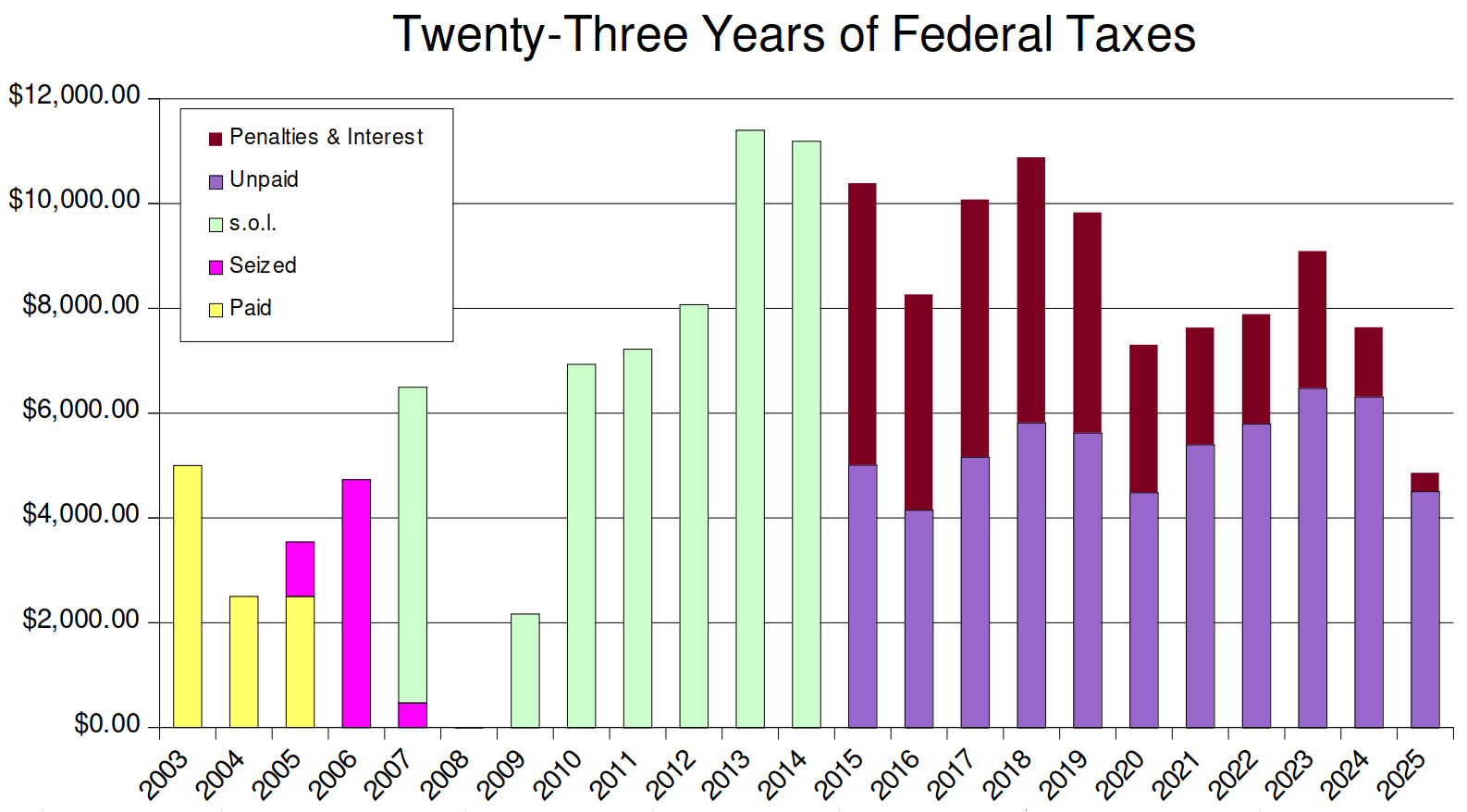
 After all the dust settled, <time datetime="2025">last year</time> I “owed” and refused to pay $4,501 in federal taxes.
</p><p>
 (I have not filed my taxes yet, so this may change once I actually sit down with the forms.
 I file paper returns for <a href="https://sniggle.net/TPL/index5.php?entry=19Dec07">reasons</a>.
 This has turned out also to be a way to measure the health of the Internal Revenue Service.
 When I began filing returns many years ago, it was typical for the government to have its tax forms ready for taxpayers to use no later than the beginning of February or so, by which time people were also receiving their W-2s and 1099s.
 If you were a keep-your-inbox-empty sort, you could file your taxes on February 1<sup class="ordinal">st</sup>, check it off the list, and smile condescendingly at people who were still scrambling in April.
 But over the past several years, the government has become less and less capable of having its forms ready by tax filing season.
 I’m still awaiting the delivery of several forms that apparently are not printed up yet, or are still stuck in their mailing queue.
 While I’m pretty confident attributing this to agency ineptitude, it’s also possibly a passive-aggressive way of discouraging people from filing paper returns.)
</p>
<figure>
 <img class="embedded" alt="In my first three years of tax resistance, I continued to pay my self-employment tax voluntarily. Then I stopped, but the I.R.S. seized enough money from me to pay for what I resisted in 2005 and 2006 and a small part of 2007. The rest of the 2007 amount hit the statute of limitations deadline, as did 2009 through 2013. Since then, the agency has collected nothing, though they continue to add penalties and interest to what they say I owe. (In 2008 I did not make enough income to owe any federal tax.)" src="https://sniggle.net/TPL/fyoft26.png" width="100%" />
 <figcaption><p class="caption">This chart shows my last twenty-three years of federal taxes.
 In my first three years of tax resistance, I avoided owing income tax but continued to pay my self-employment tax voluntarily.
 Then I stopped paying that tax, but the <abbr class="initialism caps" title="Internal Revenue Service">IRS</abbr> seized enough money from me to pay for what I resisted in 2005 and 2006 and a small part of 2007.
 The rest of the 2007 amount, as well as the 2009–13 amounts, hit the statute of limitations deadline and these are now permanently uncollectible (<abbr title="statute of limitations">s.o.l.</abbr>).
 (In 2008 I did not bring in enough income to owe any federal tax.)
 Since then, the agency has collected nothing, though they continue to add penalties and interest to what they say I owe.</p></figcaption>
</figure>
<h3>Sustainability</h3>
<p>
 I want to continue to resist taxes for the long term, so it is important (if I want to stick to my below-the-tax-line method) that my expenses remain low enough that my income-tax-free income is sustainable.
 In <time datetime="2025">2025</time> I brought in almost $32,000 in profit from my business.
 My day-to-day expenses rose, thanks to inflation and such.
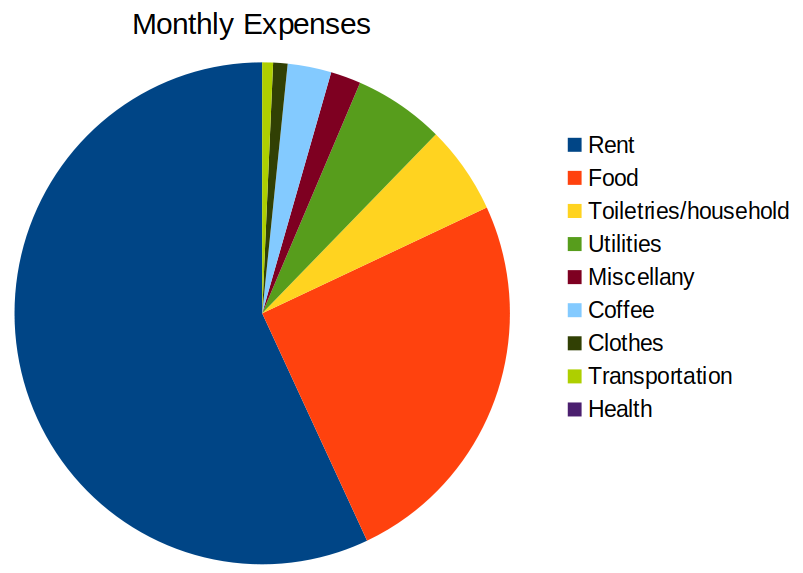
 Rents in my part of California are high, and rent amounts to nearly 60% of my annual taxable expenses.
 As best as I can estimate, my regular costs for things like rent, utilities, food, and transportation that I must pay for out of below-the-tax-line income came to about $2,133 per month, or $25,600 a year:
</p>
<figure>
 <img class="embedded" alt="Rent takes up more than half of my total monthly expenses. Food &amp; coffee, household necessities, and utilities take up most of the rest." src="https://sniggle.net/TPL/fyome26.png" width="100%" />
 <figcaption>
  <p class="caption">a look at my typical monthly expenses</p>
 </figcaption>
</figure>
<p>
 Not included in the above pie chart are any business expenses that I can deduct from my taxable income, most healthcare expenses (which I could pay for from my pre-tax Health Savings Account), my self-employment tax assessment (half of which I can deduct), or money I put aside for retirement (which I typically do in tax-deferred accounts).
</p><p>
 I now rent an apartment at which many of the utilities are bundled into the rent.
 This makes it difficult to compare expenses over time, as in some past years utilities were a more significant distinct line-item.
</p><p>
 My transportation budget is very low because where I live it’s easy to get around on bike and so I don’t own a motor vehicle and rarely need to use one.
 I’ve also been learning to do my own bike repairs and maintenance at the local “bike kitchen,” which keeps my costs even lower.
</p><p>
 My health expenses were low last year, so I didn’t have to dip into my Health Savings Account.
 It’s replenished enough to more than cover my deductible in case I run into bad health luck.
 I use it more as an additional retirement savings vehicle than for health expenses these days.
</p><p>
 My yearly living expenses take up pretty much all of my “under the tax line” budget, but I’ve got enough squirreled away in savings now that I don’t feel like I’m cutting things too close for comfort.
</p><p>
 However, if I were to budget-in the imposed self-employment tax (which I don’t intend to voluntarily pay, but which could be seized from me), that would come to another $4,500 or so of expenses, half of which also counts against my under-the-tax-line budget.
 And even if the government never gets its hands on that money, I’ve adopted the practice of making charitable donations to match the amount of my back taxes that become uncollectible due to the statute of limitations.
 For example, if my oldest tax debt is voided by the statute of limitations <time datetime="2026-05">next month</time>, I hope to write a check for $5,007 to some charity to celebrate.
 I can’t do that within my budget: I have to dip into savings, and I may ultimately have to tap my retirement accounts if I want to keep that up year after year.
 But I don’t expect this will be any great sacrifice or that it will cause any insurmountable personal hardship; I think I have a sufficient buffer for this.
</p>
<h3>My 1040: A walk-through</h3>
<p>
 Here’s how I expect my 1040 will work out <time datetime="2026">this year</time>.
 First, my Total Income:
</p>
<table class="tax" summary="My “total income” — business income plus capital gains plus an IRA conversion — added up to $44,914">
 <tfoot>
  <tr><th scope="row" abbr="total income"><b>Total Income</b></th><td class="comma"><b>$44,914</b></td></tr>
 </tfoot>
 <tbody>
  <tr><th scope="row" abbr="income">Business income</th><td class="comma">$31,859</td></tr>
  <tr><th scope="row" abbr="cap gains">Capital gains</th><td class="comma">$8,881</td></tr>
  <tr><th scope="row" abbr="Roth conversion">Roth conversion</th><td class="comma">$4,174</td></tr>
 </tbody>
</table>
<p>
 My business income is from my consulting work as a technical writer and from sales of my books.
 That income was lower than anticipated this year (my billable hours can vary wildly from month to month, which makes annual income targets hard to hit).
 This left me a lot of extra room in my zero-tax-bracket, so I took advantage of this by selling a small cache of gold and silver coins I’d bought years ago.
 Apparently you can’t get the 0% low-taxable-income long-term capital gains rate on precious metals like this.
 The best you can do is your marginal income tax rate.
 But for me this year that rate is zero, so with that and the recent spikes in gold and silver prices, it was a good time to sell.
 After selling all I had, I still had $4,000+ room in my 0% bracket, so I converted some of my traditional IRA to my Roth IRA so I could keep that money income-tax-free from here out.
</p><p>
 Now on to my Adjusted Gross Income:
</p>
<table class="tax" summary="From my total income, subtract my S.E.P., H.S.A., and IRA contributions, and half of my self-employment tax to come up with my Adjusted Gross Income of $23,464">
 <tfoot>
  <tr><th scope="row" abbr="A.G.I."><b>Adjusted Gross Income</b></th><td class="comma"><b>$23,464</b></td></tr>
 </tfoot>
 <tbody>
  <tr><th scope="row" abbr="income">Total Income</th><td class="comma">$44,914</td></tr>
  <tr><th scope="row" abbr="H.S.A."><abbr class="initialism caps" title="Health Savings Account">HSA</abbr> deduction</th><td class="comma">−$5,300</td></tr>
  <tr><th scope="row" abbr="half FICA">½ self-employment tax</th><td class="comma">−$2,251</td></tr>
  <tr><th scope="row" abbr="S.E.P."><abbr class="acronym caps" title="Simplified Employee Pension">SEP</abbr> deduction</th><td class="comma">−$5,900</td></tr>
  <tr><th scope="row" abbr="IRA"><abbr class="acronym caps" title="Individual Retirement Account">IRA</abbr> deduction</th><td class="comma">−$8,000</td></tr>
 </tbody>
</table>
<p>
 <time datetime="2025">Last year</time>, I put away $13,900 for retirement and another $5,300 for either current medical spending or for retirement.
 Together, those savings represent more than 42% of my income.
</p><p>
 The self-employment tax deduction works like this:
 When you work for someone else, that employer pays half of your <abbr class="acronym caps" title="Federal Insurance Contributions Act">FICA</abbr> and the other half comes out of your paycheck.
 This means the half paid by your employer doesn’t count as your income and so you don’t pay income tax on it.
 If you’re self-employed, you are supposed to pay both halves of the tax, so the <abbr class="initialism caps" title="Internal Revenue Service">IRS</abbr> lets you take half (roughly) of your self-employment tax as an income tax deduction to even things out (even if you’re refusing to pay, like I am<a href="https://sniggle.net/TPL/index5.php?entry=17Mar06">♦</a>).
</p><p>
 My Adjusted Gross Income is below the $23,750 threshold at which I get the maximum rate on the <a href="https://sniggle.net/TPL/index5.php?entry=8880">Retirement Savings Contributions Credit</a>.
 That is the target I try to hit in order to get my federal income tax down to zero.
</p><p>
 Now we go from Adjusted Gross Income to Taxable Income:
</p>
<table class="tax" summary="Subtract the standard deduction and qualified business income deduction from my adjusted gross income to get my Taxable Income: $7,714">
 <tfoot>
  <tr><th scope="row" abbr="taxable income"><b>Taxable Income</b></th><td class="comma"><b>$7,714</b></td></tr>
 </tfoot>
 <tbody>
  <tr><th scope="row" abbr="A.G.I.">Adjusted Gross Income</th><td class="comma">$23,464</td></tr>
  <tr><th scope="row">Standard deduction</th><td class="comma">−$15,570</td></tr>
  <tr><th scope="row" abbr="Q.B.I. deduction">Qualified Business Income deduction</th><td class="comma">−$0</td></tr>
 </tbody>
</table>
<p>
 The Qualified Business Income deduction is 20% of that portion of my income that comes from self-employment, capped at 20% of what my taxable income would be without the deduction, but minus my capital gains.
 The first Trump administration cut corporate income taxes, and this deduction was designed to give a similar break to non-corporate business entities (like me) who declare business earnings on our personal income tax forms.
 In most years since this deduction was enacted I have qualified for it, but this year my capital gains disqualified me.
 It has never actually made a difference to the bottom line of how much I owe, though.
</p><p>
 Anyway, from there, my tax owed:
</p>
<table class="tax" summary="Add my assessed income tax and my self-employment tax, then subtract the retirement savings contribution credit, to come up with $4,501 as the amount of tax I ostensibly owe.">
 <tfoot>
  <tr><th scope="row" abbr="tax owed"><b>Tax owed</b></th><td class="comma"><b>$4,501</b></td></tr>
 </tfoot>
 <tbody>
  <tr><th scope="row" abbr="tax">Income Tax</th><td class="comma">$771</td></tr>
  <tr><th scope="row" abbr="credit"><a href="https://sniggle.net/TPL/index5.php?entry=8880">Retirement Savings Contributions Credit</a></th><td class="comma">−$771</td></tr>
  <tr><th scope="row" abbr="self-employment">Self-employment tax</th><td class="comma">$4,501</td></tr>
 </tbody>
</table>
<p>
 I plan to file a tax return that shows these accurate amounts, but I will not include a check for the tax due.
</p>
<h2>Other Goals</h2>
<p>
 I hope other people will resist their taxes too, and I have tried to make <cite class="tpl">The Picket Line</cite> a good resource for people who are resisting or considering it.
 But I’ve been much less active on this front lately.
 A while back I stepped back from the blog and stopped creating new content for it.
 I’d gotten tired of being a tax resistance scholar and activist, and felt like decentering tax resistance in my life, to make it more incidental, and to occupy myself more with other pastimes.
</p><p>
 I did however create a free, on-line version of <a href="https://sniggle.net/TPL/TaxStrikeTactics/"><cite class="book">Tax Strike Tactics</cite></a> — an updated version of my book <cite class="book">99 Tactics of Successful Tax Resistance Campaigns</cite>.
 And I spoke on a <abbr class="acronym caps" title="National War Tax Resistance Coordinating Committee">NWTRCC</abbr> panel about “Resisting Taxes in the Trump Era.”<a href="https://sniggle.net/TPL/index5.php?entry=04May25">♦</a>
 It continues to baffle me how few ostensible political activists, principled “opposition” partisans, allegedly god-fearing Christians, and so forth, are willing to consider stopping their support of trumpery and its bipartisan and bureaucratic enablers.
 (There <a href="https://www.theguardian.com/us-news/2026/mar/11/trump-income-tax-protest">are</a> <a href="https://www.currentaffairs.org/news/why-im-not-paying-my-federal-taxes-this-year">some</a>!)
 In general, the American people seem doomed to support the government no matter how <i lang="la">reductio ad absurdum</i> that gets.
 But now I’ve just baked that in to my worldview and am trying to Stoically observe it and let it go without getting worked up about it.
</p><p>
 Much of my “activism” of late is less focused on politics and protest and rebellion, particularly on the national/global scale, and much more focused on embarrassingly wholesome direct action at the local scale.
 I’ve been volunteering regularly for the local food bank at one of our farmers’ markets, bringing thousands of pounds of fresh donated produce to a food pantry to give to hungry families.
 And I’ve been working as operations manager for a mobile shower trailer program that serves homeless people in our community several times a week.
 As a side project there, last year I created <a href="https://vivaslo.org/"><i>VivaSLO!</i></a>, a free on-line guide to avoiding, surviving, and escaping homelessness in San Luis Obispo county.
 (All of this volunteer work is easier for me because of the reduced and more-flexible work hours that are part of my tax resistance, and so can be seen as another form of tax <em>redirection</em>.<a href="https://sniggle.net/TPL/index5.php?entry=09May08">♦</a>)
</p><p>
 I’ve also been continuing my work on <a href="https://www.lesswrong.com/s/xqgwpmwDYsn8osoje">a sequence of essays examining the virtues and how to improve in their practice</a>.
 It has been an unexpected delight this year to discover that <a href="https://www.lesswrong.com/posts/Deko7pzwQRjvCSLs9/listing-the-virtues-from-claude-s-constitution">virtue-oriented guidance</a> has become one of the best tools yet discovered for <a href="https://www.anthropic.com/constitution">guiding the development of the <abbr class="initialism caps">AI</abbr> characters</a> who are becoming so important in our lives.
 This makes my virtue-scholarship, which at times could feel like nostalgic throwbacks to unfashionable ways of thinking about ethics, feel prescient and very now after all.
</p>
<h2>Prospects for the coming year</h2>
<p>
 We are in an era of (among other things) considerable uncertainty regarding the future (or even the present) of the tax code.
 But assuming tax law (or its equivalent in trumpery) remains more or less the same, and assuming no major unexpected expenses or windfalls, I’m well-positioned to live comfortably and well under the income tax line again <time datetime="2026-03-19/2027-03-18">in the coming year</time>, though I will again likely “owe” (and refuse to pay) self-employment tax.
</p><p>
 I’ve prepared for the possibility that the <abbr class="initialism caps" title="Internal Revenue Service">IRS</abbr> may try to seize money from me for unpaid back taxes, so in case this happens, it won’t be a disaster.
 And, if they fail again, I’m also prepared to dip into my savings to give to charity in celebration.
</p><p>
 So on to <time datetime="2026-03-19/2027-03-18">year twenty-four</time> of my “experiment.”
</p>
</article>]]></content:encoded>
  <link>https://sniggle.net/TPL/index5.php?entry=19Mar26</link>
<dc:creator>David Gross</dc:creator> </item>
</rdf:RDF>