


Superconductor expert Ranga Dias and particle theorist Jayden Newstead are our guests this week
New measurements show that extremely cold water has both a high-density and a low-density phase
Sodium ytterbium (III) selenide could become a new platform for studies of high-temperature superconductivity
Simulation suggests a smooth transition to a metal at high pressure
Janus particles are driven by gradients in surface tension
Electron spin current is generated without the need for large external magnetic fields
Counter-intuitive effect created in a vibrating liquid
New bioinspired material could protect surfaces such as aircraft wings and wind turbines
Surface tension, not gravity, is responsible, say researchers

Whether you’re still working out your career pathway or have a specific role in mind, we’re here to help. Bringing a diverse range of opportunities for jobseekers at all career stages, we’ll help you take the next step in your career and find the perfect job.
 Read article: Physics in the pandemic: ‘Our event had grown from a hub for the UK to a truly global event within a matter of days’
Gunnar Moeller from the University of Kent in the UK describes how this year's Condensed Matter Physics in the City was turned into an online-only event
 Read article: Diamond defects reveal viscous currents in graphene
Researchers image nanoscale magnetic field fluctuations in 2D carbon at room temperature
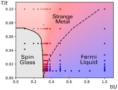 Read article: ‘Reluctant’ metals make a new state of matter
New computation model of "strange" metals could shed light on high-temperature superconductors and black holes
 Read article: Time-varying signals control sound waves in topological metamaterials
New work could have applications in ultrasound imaging, sonar and low-power electronic devices that can operate in harsh or hazardous environments
 Read article: Second critical point appears in two models of water
Computations suggest that supercooled water exists in two distinct liquid phases
 Read article: Magnetic topological insulators change phase under pressure
Scientists develop a simple way of tuning the crystal structure and electronic properties of these layered materials
 Read article: Experiments pin down conditions that make hot water freeze before cold
Simplified experimental model makes it possible to engineer the Mpemba effect in a reproducible way
 Read article: Superconductivity theory comes a step closer
New model attempts to mimic electron behaviour in overdoped cuprates
 Read article: Liquid metal flows smoothly at room temperatures
Applied voltage and oxide "skin" overcome droplet-forming tendencies driven by high surface tension
 Read article: 2D Fermi gas hosts ideal Josephson junction
System could help researchers better understand strongly interacting superfluids
 Read article: Nanostructured topological insulator growth speeds up
Technique produces highly conductive crystalline nanoribbons and could be used to make even thinner materials in the future
 Read article: Weak electric currents track tiny magnetic skyrmions
New work brings real-world devices based on these whirling vortex structures a step closer to reality
 Read article: Why insulated metals cool down faster than their bare counterparts
Cryogenic experiments and a new thermodynamic model shed fresh light on the Leidenfrost effect
 Read article: Cryogenics makes the European Spallation Source a hot property in neutron science
John G Weisend II explains why cryogenics is a core enabling technology at the European Spallation Source, currently under construction in Sweden
 Read article: Webinars and white papers: Oxford Instruments presents seven webinars on nanoscience
Explore the latest technology webinars from physics-based industry in condensed matter and instrumentation and measurement
 Read article: Colour-changing probe maps stresses in soft materials
New device builds up a quantitative picture of internal forces in a structure
 Read article: Active rotation plays a role in the jamming–unjamming transition in living cells
Unjamming resembles the change in mechanical properties of healthy versus cancerous tissue
 Read article: ‘Magic-angle’ graphene doubles up
New platform could be used to investigate high-temperature superconductivity and correlated quantum phases


