


Most developers underestimate how painful document processing still is.
Invoices. PDFs. Receipts. Contracts. Financial reports.
A huge amount of business data is still trapped inside documents.
And most teams still solve this problem the same way they did 10 years ago:
- manual copy-paste,
- fragile OCR tools,
- messy spreadsheets,
- broken automations,
- and workflows that collapse the moment a PDF layout changes.
Now combine that with the rise of:
- AI agents,
- RAG systems,
- automation pipelines,
- and LLM workflows.
Suddenly, extracting clean structured data from documents becomes one of the most important layers in the entire AI stack.
That's why OCR APIs and document parsing platforms are exploding right now.
But not all tools are built the same.
Some are optimized for:
- developer workflows,
- AI-native parsing,
- invoice automation,
- enterprise document ingestion,
- or RAG pipelines.
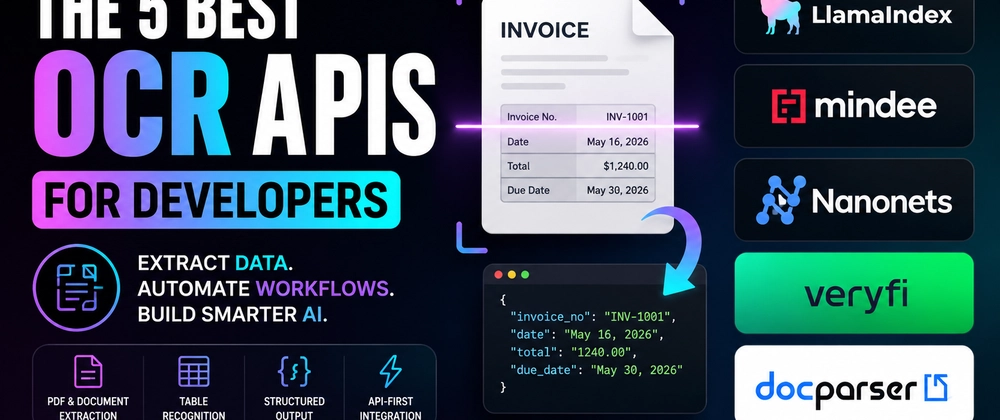
So after researching the current market, here are 5 OCR/document extraction APIs that stand out the most in 2026.
1. Nutrient Data Extraction API
The biggest challenge with document AI isn't extracting text anymore—it's getting structured, reliable data that downstream applications can actually use.
That's where Nutrient Data Extraction API stands out.
Instead of returning raw OCR output, it uses AI to identify fields, tables, line items, and key information from complex business documents, making it particularly useful for automation workflows, enterprise systems, and LLM-powered applications.
Whether you're processing invoices, purchase orders, healthcare forms, contracts, financial reports, or construction documents, the API is designed to transform unstructured files into clean JSON that developers can immediately integrate into their applications.
Best For
- Enterprise document processing
- Invoice extraction
- AI document workflows
- LLM pipelines
- ERP and CRM integrations
Key Features
- AI-powered structured data extraction
- Extracts structured data from PDFs, scanned documents, and images
- Advanced table and line-item extraction
- JSON output
- REST API
- Interactive Data Extraction Studio
- Handles complex business documents
- Supports custom extraction schemas
Pricing
- Free tier available (5,000 monthly credits)
- Usage-based pricing
- Enterprise plans available
Pros
- Excellent structured data extraction accuracy
- Built for production document workflows
- Developer-friendly REST API
- Great documentation
- Interactive Studio for testing extraction
- Supports a wide variety of business document types
Cons
- Optimized for structured document extraction rather than simple OCR
- Advanced enterprise workflows may require some initial configuration
🚀 Try Nutrient Data Extraction API: Transform PDFs, scanned documents, and images into structured JSON using AI. Start for free with 5,000 monthly credits and test your own documents in the interactive Studio.
👉 https://www.nutrient.io/api/data-extraction-api/
2. LlamaParse (LlamaIndex)
LlamaParse is probably the most interesting OCR/document parsing platform right now for AI engineers.
Why?
Because it's not just "OCR".
It's built specifically for:
- LLMs
- AI agents
- RAG systems
The difference matters.
Traditional OCR extracts text. LlamaParse tries to preserve semantic structure and context.
Best For
- RAG systems
- AI agents
- Financial reports
- Complex PDFs
- LLM ingestion pipelines
Key Features
- AI-native parsing
- Markdown and JSON outputs
- Advanced table extraction
- Multi-modal parsing
- Agentic parsing modes
- Complex layout understanding
Pricing
- Free tier available
- Credit-based pricing
- Around 10,000 free credits/pages monthly depending on parsing mode
Pros
- Excellent for complex PDFs
- Built for AI workflows
- Strong parsing quality
- Great ecosystem for developers
Cons
- More expensive at scale
- Overkill for simple OCR use cases
- Requires understanding of RAG/LLM workflows
3. Mindee
Mindee is one of the most developer-friendly OCR APIs available today.
Fast setup. Excellent documentation. Very practical APIs.
This is the kind of tool developers love because you can go from "PDF chaos" to "working automation" in a few hours.
Best For
- Python developers
- OCR automation
- Invoice extraction
- Receipt OCR
- API integrations
Key Features
- Invoice OCR
- Receipt OCR
- Passport/document parsing
- Python SDK
- API-first architecture
- Batch processing
Pricing
- Starter plan: ~€44/month
- 500 pages included
- Usage-based scaling available
Pros
- Extremely developer-friendly
- Great documentation
- Strong API ecosystem
- Fast implementation
Cons
- Less focused on advanced RAG
- Enterprise AI features more limited than some competitors
4. Nanonets
Nanonets sits somewhere between OCR platform, AI workflow engine, and automation suite.
Instead of focusing only on extraction, they focus heavily on business automation.
This makes it attractive for companies that want OCR, approvals, integrations, AI extraction, and workflows together.
Best For
- Business automation
- Finance operations
- Invoice processing
- AI document workflows
Key Features
- AI OCR
- Workflow automation
- Table extraction
- ERP integrations
- Email ingestion
- Approval systems
Pricing
- Free credits available
- Pay-as-you-go model
- Enterprise plans available
Pros
- Strong automation capabilities
- Enterprise-friendly
- Powerful extraction workflows
- Good UI
Cons
- Less developer-focused
- Can become expensive with volume
- More business-oriented than technical
5. Veryfi
Veryfi is heavily specialized in receipts, invoices, bookkeeping, and financial OCR.
And honestly, that focus is a strength.
Instead of trying to solve every OCR problem, they dominate a very specific niche extremely well.
Best For
- Fintech
- Expense management
- Accounting automation
- Receipt scanning
Key Features
- Receipt OCR
- Invoice extraction
- Expense categorization
- Fraud detection
- Mobile OCR
- Financial automation
Pricing
- API-based pricing
- Enterprise-focused plans
- Free trial available
Pros
- Very accurate for receipts/invoices
- Strong financial workflows
- Good mobile support
Cons
- Narrower use cases
- Less useful for general-purpose document parsing
BONUS. Docparser
Docparser is one of those tools you understand in 30 seconds.
Upload a PDF. Extract structured data automatically. Connect it to Zapier, Make, or n8n. And remove hours of manual work.
It doesn't try to be an "AI operating system." And honestly, that's part of the appeal.
It's extremely focused on solving one problem well: extracting structured data from documents reliably.
Best For
- Business automation
- Invoice extraction
- PDF workflows
- No-code automation
- Operations teams
Key Features
- OCR + PDF parsing
- Table extraction
- Template-based parsing
- Zapier integrations
- Email parsing
- API access
- Export to Excel/CSV/JSON
Pricing
- Starter plan around $39/month
- Professional plans available
- Free trial included
Pros
- Very easy to use
- Great for automations
- Fast setup
- Strong integrations
Cons
- Less AI-native than LlamaParse
- Complex documents may require setup
- More template-driven
Final Comparison
| Tool | Best For | AI-Native | Pricing Model | Developer-Friendly |
|---|---|---|---|---|
| Nutrient Data Extraction API | Enterprise document extraction, AI workflows | ✅ Yes | Free tier + Usage-based | ⭐⭐⭐⭐⭐ |
| LlamaParse | RAG / LLM pipelines | ✅ Yes | Credits | ⭐⭐⭐⭐ |
| Mindee | Invoice / Receipt OCR | Partial | Per page | ⭐⭐⭐⭐⭐ |
| Nanonets | Business automation | Partial | Pay-as-you-go | ⭐⭐⭐ |
| Veryfi | Fintech / Expense management | Partial | API-based | ⭐⭐⭐ |
| Docparser | No-code document automation | ❌ No | Monthly plan | ⭐⭐⭐⭐ |
FAQs
What is the best OCR API for developers?
Mindee is probably the best balance between ease of use, pricing, documentation, and developer experience.
Which OCR tool is best for RAG systems?
LlamaParse and Unstructured are currently among the strongest options for AI-native document pipelines.
Which OCR API is best for invoices and receipts?
Veryfi, Mindee, and Nanonets are excellent for financial documents and expense automation.
Are OCR APIs expensive?
Most platforms now offer free tiers, pay-as-you-go pricing, or credit systems. Costs mainly depend on document volume and complexity.
Can OCR APIs work with Python?
Yes. All the platforms mentioned here provide APIs and Python integrations.
Final Thoughts
The OCR market is no longer just about extracting text.
The real opportunity now is building systems that understand documents and transform them into structured, actionable data.
If you're building AI applications, automation workflows, or enterprise document processing pipelines, Nutrient Data Extraction API is one of the strongest platforms currently available thanks to its AI-powered extraction capabilities, developer-friendly API, and interactive testing Studio.
For AI-native document parsing, LlamaParse remains an excellent option, while Mindee, Nanonets, Veryfi, and Docparser continue to be strong choices depending on your specific use case.
As AI agents and automation become more common, reliable document extraction will increasingly become one of the core building blocks of modern software.
Looking for technical content for your company? I can help — LinkedIn · kevinmenesesgonzalez@gmail.com



Top comments (0)